The Email That Says You Cheated, When You Didn't
The notification lands before you've even had coffee. A flag on your submission. A percentage next to your name. Your professor, or your client, or your editor, wants to talk.
And you didn't do anything wrong. You wrote every word yourself. But now you're the one who has to prove it, against a tool that doesn't show its work, and a decision maker who's already half convinced.
This is happening more than most people realize, and it isn't happening at random.
The false positive problem is bigger than a glitch
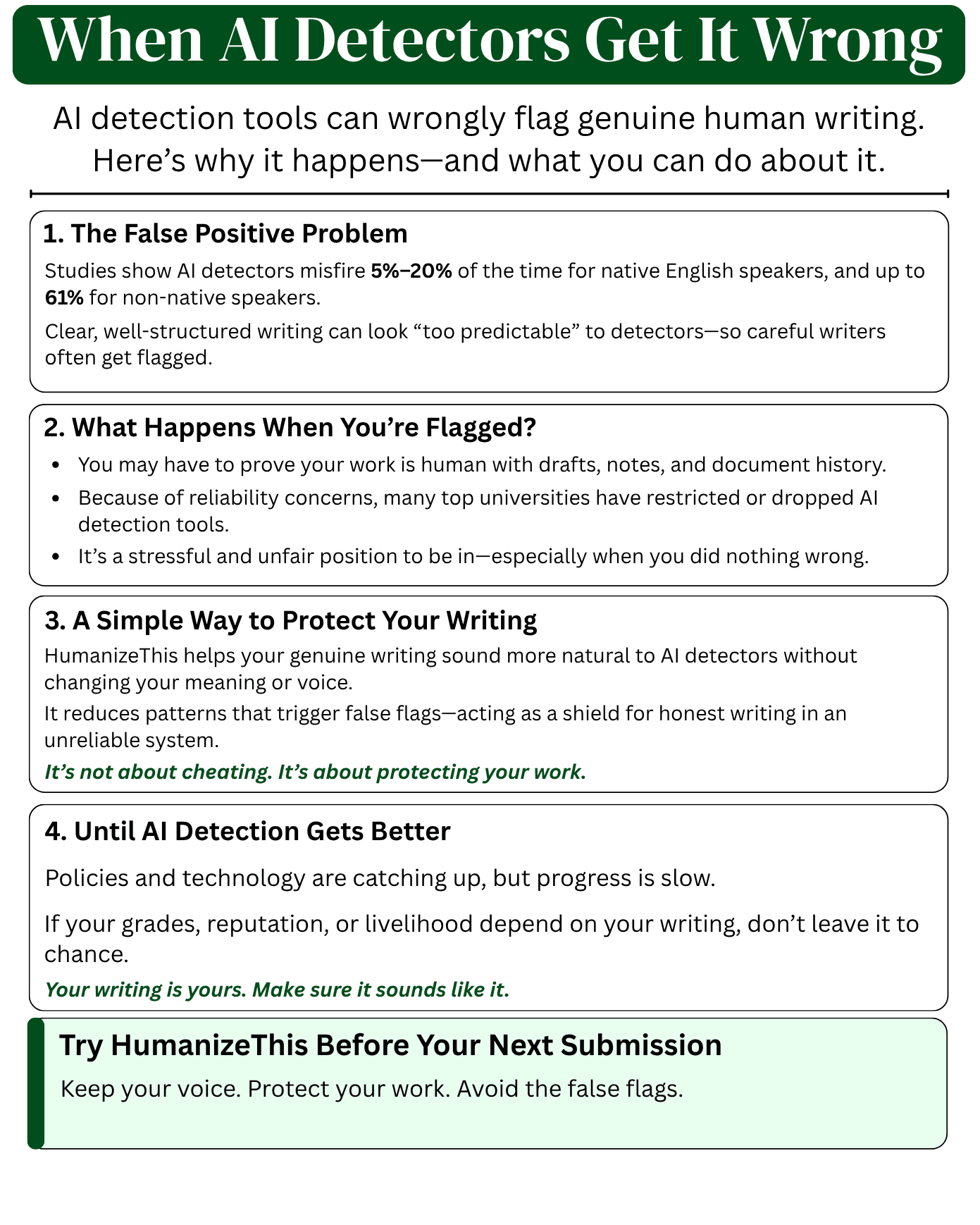
Independent testing has found AI-detection tools misfire on genuinely human writing at rates between 5% and 20% for native English speakers, and as high as 61% for non-native speakers. That second number isn't a rounding error, it means a majority of honest, careful writing from ESL students can get flagged as machine generated. Formal academic prose, the kind you were taught to write for a decade, hits the same trap: even a detection company's own product team has acknowledged their tool behaves differently in real classrooms than in lab testing, and that introductions, conclusions, and short submissions are especially prone to getting it wrong.
The consequences aren't abstract. Earlier this year, a federal judge threw out a university's finding against a first year student after the school ignored two independent detector reports that both called his paper human written, alongside drafts and notes he'd submitted as evidence. More than two dozen universities, including MIT, Yale, and UC Berkeley, have since restricted or dropped AI detection tools entirely over reliability concerns. That's not a fringe reaction. That's a lot of institutions quietly admitting the tool their faculty were told to trust can't be trusted enough.
The bitter irony: being careful makes you a target
Here's the part that stings most. The writers getting flagged aren't sloppy. They're the ones who write in complete sentences, structure their arguments clearly, and don't leave typos or tangents in a first draft. Detectors are trained to spot statistical smoothness, predictable phrasing, consistent rhythm, the exact qualities a strong writer, a disciplined student, or a careful nonnative speaker tends to produce naturally. The system built to catch shortcuts ends up punishing diligence instead.
And once you're flagged, the burden of proof lands entirely on you. Dig up your Google Docs version history. Find your outline. Explain, calmly, to someone who's already suspicious, that a machine's guess about your writing style is wrong. It's an exhausting, humiliating position to be put in for having done nothing but your own work.
Where a tool like this actually helps
This is the exact blind spot HumanizeThis exists to cover. Running your own genuine writing through it before you submit or send it doesn't change what you said or how you argued it, the meaning and your voice stay intact, it just breaks up the statistical smoothness that gets honest, careful writers mistaken for a machine in the first place. It's not a workaround for cheating. It's a shield for the writing that was never dishonest to begin with, in a system that currently offers you no other reliable one.
Institutions are slowly catching up. Policies are being rewritten, detectors are being dropped, court rulings are starting to push back on treating an algorithm's guess as proof. But that process is slow, and in the meantime, individual students, freelancers, and professionals are the ones absorbing the risk every time they hit submit.
Until the system catches up
Nobody should have to defend their own sentences to a machine that's wrong one time in five, or worse. Until AI detection gets more reliable and more accountable, the smartest move for anyone whose livelihood or grades depend on being believed is to not leave that outcome to chance. Try HumanizeThis before your next submission, and let your writing sound like exactly what it is: yours.