Twenty Letters That Sound Like One
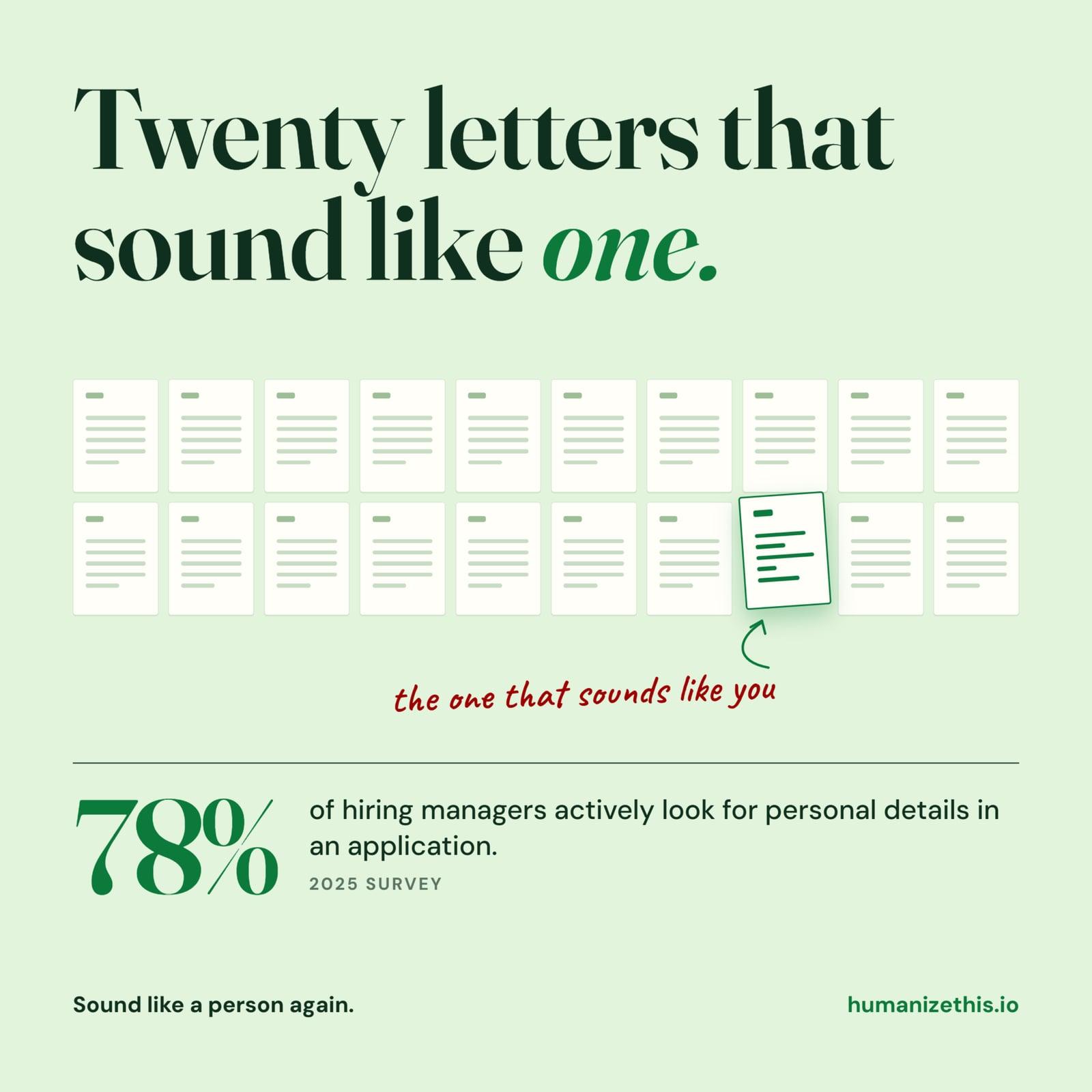
It is the thirtieth application of the afternoon. The hiring manager opens it, reads the first line, and already knows how the next three paragraphs will go. The same polite opening. The same confident adjectives. The same even rhythm, sentence after sentence, like footsteps on a treadmill.
She has nothing against the candidate. She just stopped hearing a person somewhere around the second paragraph, and she moves on to the next one.
If you have ever sent a message that was technically perfect and still got no reply, you may have been on the other side of that moment.
It is not your imagination
Readers are not the only ones noticing. A study of hundreds of thousands of texts, including Reddit stories, news articles and research abstracts, found that the variety in how people write dropped after ChatGPT arrived. In a separate controlled test, the authors had AI models rewrite human texts, and the variety narrowed there too, while the meaning stayed largely intact. The authors are open about the fact that the first part shows a correlation, not proof of cause. But the direction is hard to miss.
A paper in Trends in Cognitive Sciences this March makes a related point, as an opinion piece rather than an experiment. Its authors argue that when people use AI to polish their writing, it can lose its distinctive voice, and the writers feel less ownership of what they produced. They are careful to say this is a risk, not a settled outcome.
Hiring managers have been saying the same thing in plainer words. One 2025 survey reported that 78 percent of hiring managers actively look for personal details in an application, and recruiters keep describing stacks of letters that share almost identical phrasing.
Sameness is the quiet cost
Nobody sends you a rejection that says your writing sounded like everyone else's. It just does not land. The email gets skimmed. The proposal gets filed. The cover letter joins the pile of letters that all seem to come from the same polite, tireless stranger.
And it is not only about getting noticed. There is a smaller, more personal loss. Many people say they read their own AI assisted drafts back and feel a little detached from them. The words are fine. They just do not sound like the person who sent them.
The fix is not to give up the speed
Nobody is going back to staring at a blank page for an hour. Drafting with AI is faster, and for many people it is the difference between sending something and not sending it at all. The goal is not to stop using it. It is to make sure what leaves your hands still carries the texture of a person.
That texture is mostly small things. Sentences that run long when you are excited and stop short when you are sure. A word choice that only you would make. A rhythm that wobbles the way real thinking does.
Where a tool like this actually helps
This is the gap HumanizeThis is built to close. Paste in a draft, and it works on the surface texture, varying sentence length, loosening the too even rhythm and nudging phrasing away from the most predictable choices, while keeping your meaning and your argument in place.
It is honest about what it cannot do. It will not invent the specific story or detail that only you have, and it should not. That part still has to come from you. What it handles is the flatness, so the real details you add do not get buried under a uniform voice.
Sound like a person again
Your readers are tired of sameness, and they can feel it within a few lines. You do not have to choose between fast and human. Draft the way you like, add what only you know, and give the result one last pass so it reads like you meant it. Try HumanizeThis on the next thing you send.