The Tool That Makes AI Writing Sound Like You Again
There's a specific kind of dread that shows up right after you paste a ChatGPT draft into your essay, your blog post or your client deliverable. You read it back and something's off. The sentences are too clean. The rhythm is too even. It reads like it was written by something that has never been tired, distracted, or genuinely annoyed at 2 a.m. And somewhere in the back of your mind, you're already picturing the AI detection flag that might come with it.
That exact moment of dread is the entire reason apps like HumanizeThis exist.
The site opens with a promise that's almost disarmingly simple. You paste in AI generated text, click one button and just like that you get something back that reads human. No tutorials, no settings to configure before you even understand what they do. Just a box, a button, and a percentage score that tells you how likely the result is to pass as human written. According to the site, it's already processed more than three million words for people trying to solve this exact problem.
What's interesting isn't the pitch. Every AI tool promises to save you time. What's interesting is who's actually using it, and why. Take the PhD candidate juggling a thesis and a teaching load, quoted on the site describing how she used the tool to clean up her literature review drafts without disturbing her citations or her argument. Or the content director who used to have three people manually editing AI drafts until the workflow got simple enough that one person could do it.
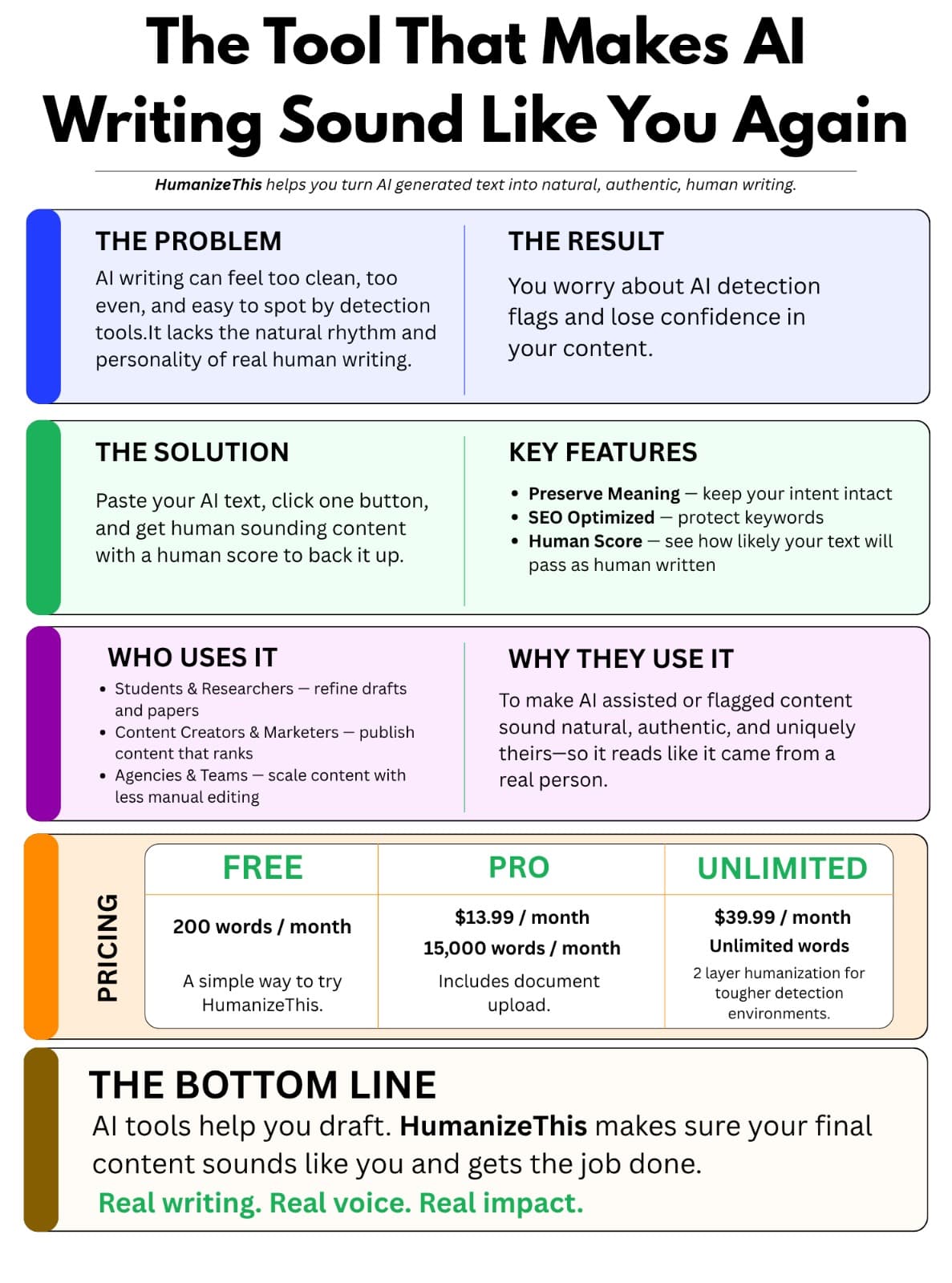
Mechanically, the tool works less like a synonym swapper and more like an editor with a very specific mandate: keep the meaning, break the pattern. It varies sentence length, roughs up rhythm that's too consistent, and nudges phrasing away from the statistically predictable choices that detection models are trained to spot. The site is upfront that the goal is to preserve your original intent while making the surface texture of the writing feel less machine authored. A “Preserve Meaning” feature is built specifically around not letting the rewrite drift from what you actually meant to say, and an “SEO Optimized” mode keeps your target keywords intact through the rewrite, which matters if you're a content team worried about search rankings, not just detection scores.
AI detection tools like Turnitin, GPTZero, and Copyleaks are blunt instruments. They flag false positives and can't genuinely tell the difference between a naturally tidy writer and a machine. HumanizeThis exists in the space that ambiguity created.
Pricing follows the shape you'd expect from a tool like this. There's a free tier capped at 200 words a month, clearly meant as a taste rather than a workflow. The Pro tier, at $13.99 a month, jumps to 15,000 words and adds document upload, which is where researchers and regular writers actually live. At the top, an Unlimited tier at $39.99 a month is built for agencies and high volume teams running dozens of pieces of content through the system every week, complete with what the site calls “2 layer humanization” for tougher detection environments.
In essence, what ties all users together is the same underlying need, which is to have writing that reads like it came from someone who was actually thinking while they typed. Some are polishing work they wrote themselves that got caught by an overcautious detector, while others are taking a first draft built with AI assistance and shaping it into something that carries their own voice before it goes out under their name. Either way, the finish line is the same, text that sounds like a person, not a pattern.
That's really the case for HumanizeThis. AI writing tools are now a permanent part of how people draft, brainstorm, and move faster, and the expectation that published work still sound human isn't going anywhere either. HumanizeThis sits right in that gap, built for anyone who needs their words to read like they were written by someone with a point of view, not assembled by a machine.
For students, marketers, researchers, and writers juggling more deadlines than hours in the day, that's less a philosophical question and more a practical one: does the writing sound like you, and does it get the job done. HumanizeThis is built to answer yes to both.