Three Drafts In, and Every One Sounds Like Someone Else
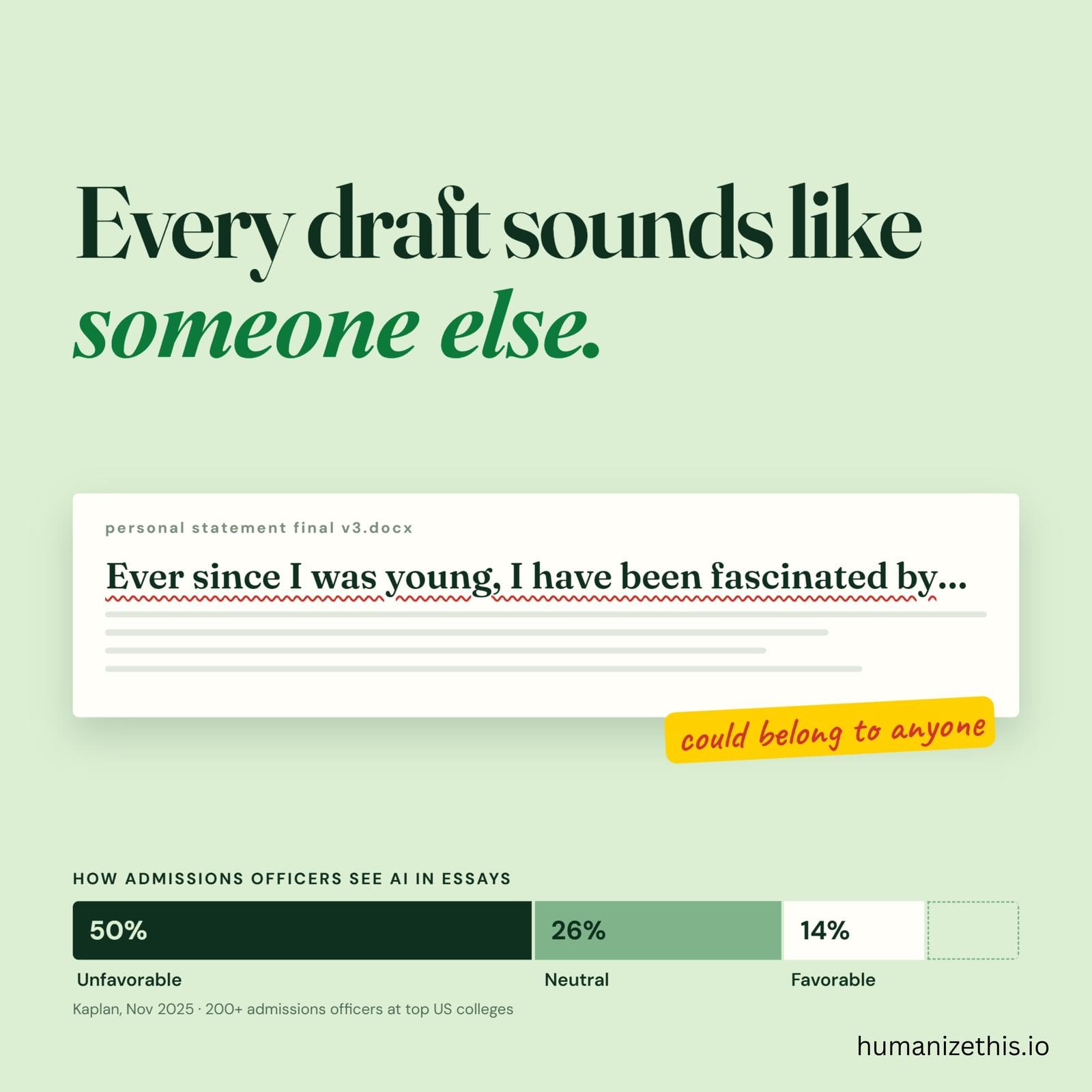
It is mid November and the deadline is three weeks away. You have a document open called personal statement final v3, which is a small lie, because you know there will be a v4.
You read the first line back. Ever since I was young, I have been fascinated by. It is clean. It is confident. And it could belong to literally anyone who has ever applied to anything.
Readers are listening for one thing
In November 2025, Kaplan published a survey of more than 200 admissions officers at top US colleges, polled by email over the summer. Half of them, 50 percent, had an unfavorable view of generative AI in application essays, 26 percent were neutral and 14 percent were favorable. The reason officers gave is worth noticing. They said AI can make essays generic and hide a student's authentic voice.
To be fair, that survey covers college admissions, and what officers say they notice is self reported. But anyone who sits down with a tall stack of essays is listening for the same thing, which is a real person. They are not hunting for the cleverest sentence. They are waiting for the moment the writing sounds like someone in particular.
Policies vary too. In the same survey, 30 percent of schools banned using AI to write the essay and 68 percent had no official policy on it, so read the instructions on each application you send.
Why every draft starts to sound alike
Here is the quiet trap. You write something honest, it feels rough, and you smooth it. Then you smooth it again. Each pass swaps a specific word for a safer one and evens out the rhythm. By version three the sentences all run about the same length, the adjectives are the ones everyone reaches for, and the whole thing has the calm tone of a brochure.
Nothing in it is false. It has simply lost the bumps that made it yours.
The part nobody else has
The thing that makes a statement memorable is almost never the polish. It is the radio you took apart at eleven because you needed to know how it worked. The experiment that failed three times before it taught you anything. The day a teacher said one sentence that changed what you chose to study.
Those details are yours, and no tool can invent them for you. So start there. Write the true, specific moment first, in plain words, even if it comes out messy. Everything after that is about helping those details be heard.
Where a tool like this actually helps
This is where HumanizeThis fits. Once your real story is on the page, paste in the draft and it works on the texture. It varies sentence length, loosens the too even rhythm and nudges phrasing away from the most predictable choices, while keeping your meaning in place. With the Preserve Meaning option on, your argument and your examples stay put.
It will not write the story about the radio. That has to come from you. What it does is make sure the story is not buried under a smooth, uniform voice, so the reader hears a person and not a template.
Sound like the person you are
Three weeks is enough time to do this well. Write the moment only you can write, give the draft one last pass so it reads like you meant it, and send it knowing it sounds like you. Try HumanizeThis on your next draft before you call it final.