A Number Now Sits Next to Your Newsletter
You spent your whole Sunday on this issue. You rewrote the opening three times. You cut a paragraph you loved because it slowed the middle. You hit publish, closed the laptop, and felt the small quiet pride of having said something properly.
Then a reader you have never met opens your post, taps a button, and sees a percentage. An estimate of how much of what you wrote came from a person and how much came from a machine.
You never agreed to be graded. But there it is.
The scanner is now part of the platform
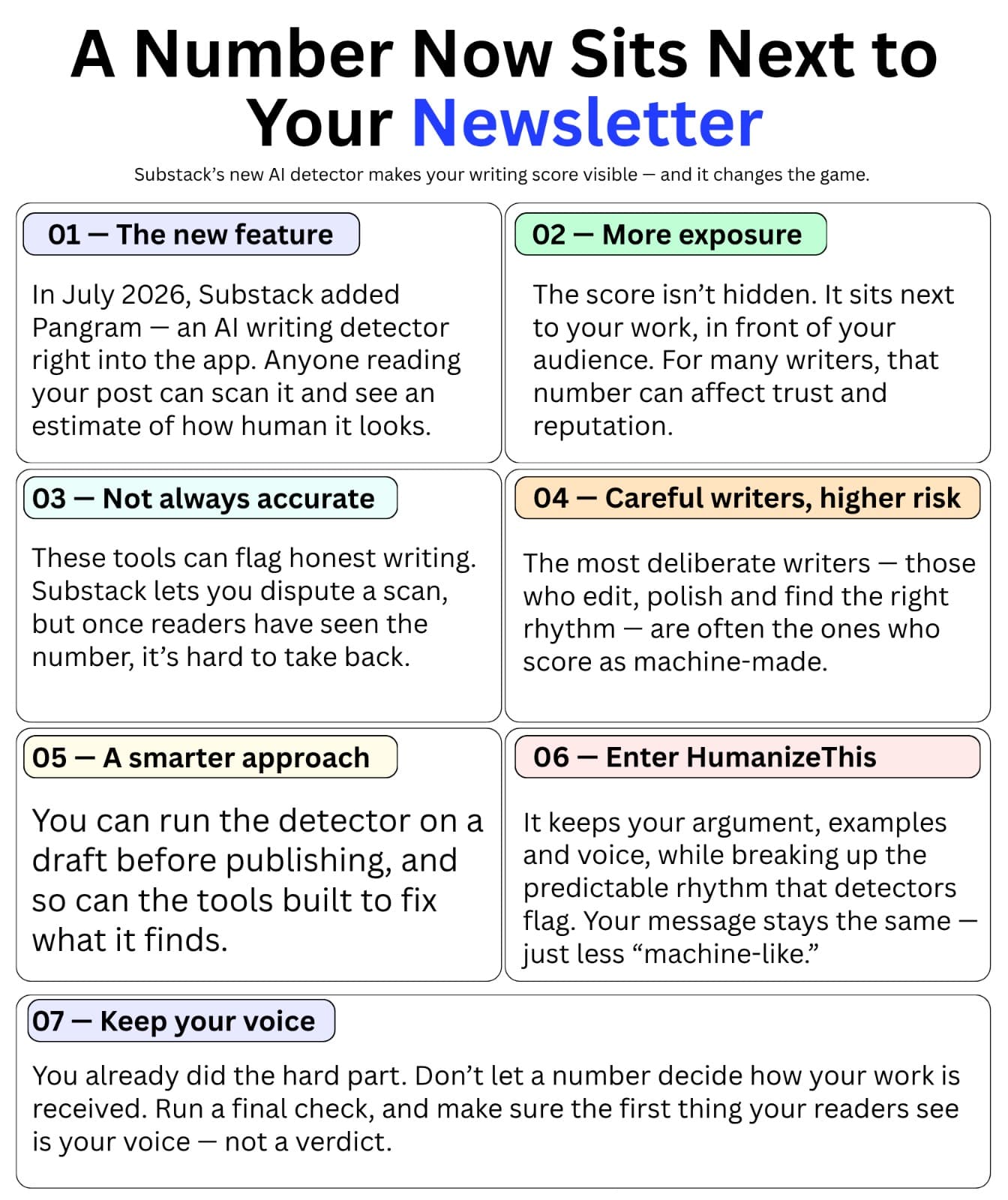
In July 2026, Substack built Pangram, an AI writing detector, directly into its app. Readers can scan posts, notes, replies and comments over a hundred characters and get an estimate of how human the writing looks. It is not hidden in a settings menu for administrators. It is a feature anyone reading your work can use.
Substack has been clear about its intent. The company says the tool is not meant to ban or punish writing that involved AI. Writers can add an optional author's note explaining how they work, and Substack encourages a short statement about how a piece gets made. Publishers can also report a scan they believe is wrong, and they can run the detector on their own drafts before anything goes live.
That last part matters, and we will come back to it.
This is a different kind of exposure
Most of what we have written about so far is private judgment. A professor reviewing a paper. A recruiter filtering applications. A feed quietly deciding who gets to see your post. In every one of those cases, the verdict arrives hidden, if it arrives at all.
This one is out in the open. The score lives next to your work, in front of your audience, and anyone can pull it up whenever they like. For a writer who built a readership on trust, that changes something. A newsletter is a promise that a real person is thinking on the other end. A number that questions that promise, right or wrong, lands on your reputation, not just on your draft.
And the number is only an estimate. Critics have raised concerns that tools like this can flag honest writing, which is the same worry that has followed detectors everywhere they have been used. Substack does let writers dispute a scan, but disputing a number after readers have already seen it is a much worse position than never having it appear.
Careful writers have the most to lose
Here is the irony that keeps repeating. The writers most likely to produce text that scores as machine made are often the most deliberate ones. You edit for clarity. You cut tangents. You smooth the rhythm until it reads easily. Those are exactly the habits pattern based detectors tend to associate with generated text.
A messy, rushed post full of half finished thoughts might read as more human than a piece you polished for six hours. That should not be how this works. But it is how a lot of detectors behave, and now that one lives inside the reading experience, the polish you are proud of can quietly count against you.
Where a tool like this actually helps
Substack itself suggests the move. If publishers can run the detector on a draft before publishing, so can you, and so can the tool built to fix what it finds.
This is where HumanizeThis fits. Paste in a draft you are about to send, and it keeps your argument, your examples and your voice, while breaking up the overly even rhythm and predictable phrasing that detectors react to. It does not change what you meant to say. It changes how evenly it is said, so that a careful writer does not end up looking like a machine just because they were careful.
Think of it as a last pass before publishing, the same way you would check a draft for typos. You are not hiding anything. You are making sure the first thing a reader sees is your work, not an estimate of your work.
Publish the piece you actually wrote
Readers are allowed to care whether a person wrote what they are reading. That instinct is fair. What is not fair is for an imperfect score to decide how they feel about writing that you laboured over honestly.
You already did the hard part. You had the idea and you found the words. Make sure the thing that travels with it into the world is your voice, not a verdict. Try HumanizeThis before your next issue goes out.