You Never Heard Back, and You Will Never Know Why
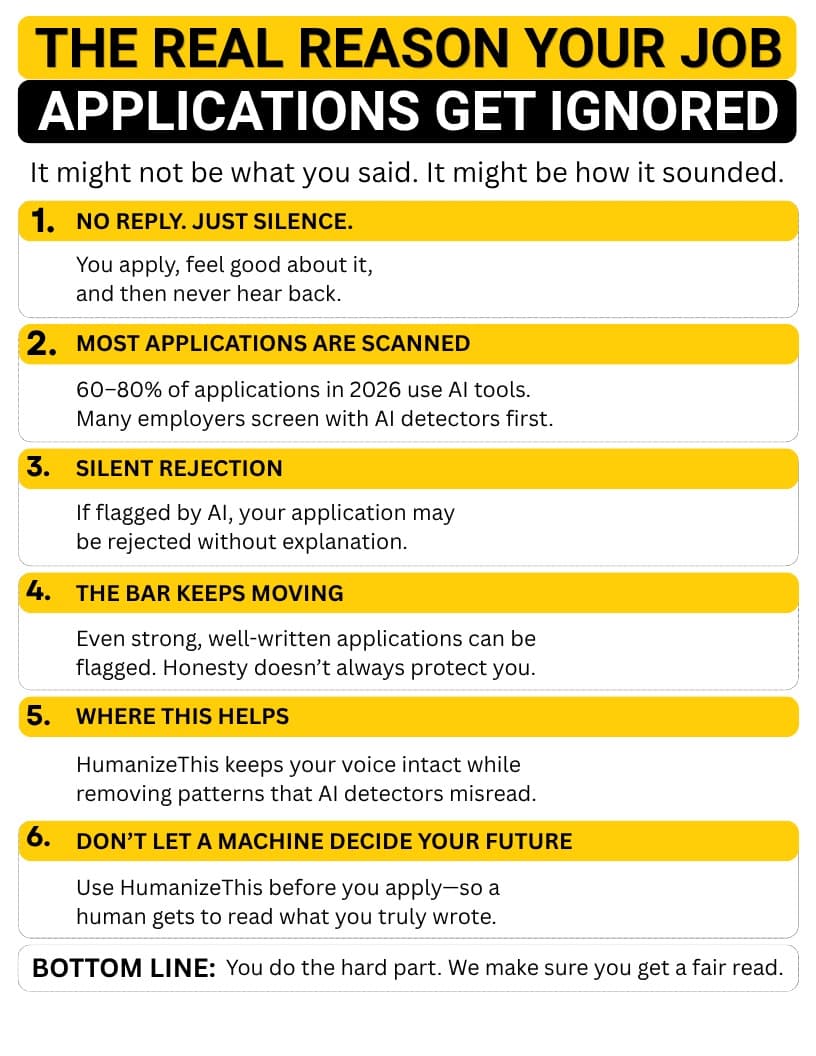
You spent an hour on that cover letter. You meant every line. You hit send, you felt good about it, and then nothing. No rejection email. No interview request. Just silence, for weeks, while you keep checking a job status page that never updates.
You start to wonder what went wrong. Was it the resume format. Was it the experience gap. Was it something you said in the letter.
Here is the possibility almost nobody warns you about. It might not have been anything you said. It might have been how it sounded.
Almost every application is being scanned now
Somewhere between 60 and 80 percent of job applications in 2026 include some form of AI assistance, according to industry estimates, and hiring teams know it. So a growing number of them are running cover letters and resumes through AI detection tools before a human ever reads a word. The tools are not reliable. Independent testing in 2026 put ten different AI detectors through 200 real resumes, and not one of them reached 90 percent accuracy. One widely used detector showed a false positive rate of nearly 14 percent specifically on writing from nonnative English speakers, meaning a real, honestly written application can get flagged as machine made simply for being careful and correct.
And here is the part that makes this so different from a classroom accusation. A flagged student can appeal to a professor. A flagged job candidate almost never finds out it happened at all. The most common outcome, according to recruiters who study this, is silent rejection. No explanation. No chance to respond. Your application just moves to a pile you never see, and you spend the next few weeks blaming your resume format instead of the real reason.
In a small number of documented cases, it goes even further. Candidates have had job offers reconsidered after HR reviewed the original application materials and spotted what looked like AI patterns, even after the offer was made. That is the nightmare version. You did everything right, you got the job, and it still came back to bite you.
The bar keeps moving, and honesty does not protect you
The frustrating truth is that being a strong writer does not make you safer here. It can make you a bigger target. Clean structure, confident phrasing, and correct grammar are exactly the traits detection tools associate with AI writing, so the better your natural writing is, the more likely it is to read as suspicious to a machine that was never built to understand nuance. Meanwhile the actual hiring advice going around tells candidates to polish their materials, use AI as a starting point, and make sure everything reads professionally. Nobody tells you that professional and polished is also what gets you quietly filtered out.
You cannot see the filter. You cannot argue with it. You will not even know it happened. The only real defense is making sure your writing never resembles the pattern it is looking for in the first place.
Where this actually helps
This is exactly the gap HumanizeThis is built to close. Run your cover letter or resume summary through it before you send it, and it keeps everything you actually wrote, your experience, your reasoning, your voice, while breaking up the kind of statistical smoothness that gets confident, well written applications mistaken for AI. It is not about faking anything. It is about making sure a hiring algorithm never gets the chance to misread your honesty as a red flag before a human even opens the file.
You already do the hard part
You research the company, you write the letter, you hit send hoping someone reads it the way you meant it. The least the process owes you is a fair read, not a silent filter deciding your fate before anyone even sees your name.
Try HumanizeThis before your next application goes out, so that if the silence still comes, at least it is not because of something you never did wrong.